White Label WordPress Development

Winning more WordPress projects sounds like growth, but more revenue does not automatically translate into stronger profitability for digital agencies.

Development expenses, recruitment, idle capacity, project reworks, updates, management time, and unexpected delays can gradually reduce the margin attached to every successful project.

That creates a common challenge for growing agencies. They need enough technical capacity to accept new opportunities, yet maintaining a large permanent team can become expensive when project demand fluctuates.

Promethean Research reported an average after-tax net margin of 13% for digital agencies in 2025. Its data also showed average margins of 19% for agencies with fewer than 10 full-time employees and 8% for agencies with 50 or more employees. These figures are industry benchmarks rather than guaranteed results for individual agencies.

A flexible delivery model can solve part of this problem by allowing agencies to scale technical resources around actual project requirements.

For many businesses, white label WordPress development provides a way to increase delivery capacity while keeping client ownership, communication, and strategic direction within the agency.

This guide explains how the model can affect profitability, where WordPress project margins are commonly lost, how to compare white-label and in-house development, and how to choose a partner without sacrificing quality or profitability.

How Does White Label WordPress Development Affect Agency Profitability?

Agency profitability depends on more than the price charged for a WordPress project. It is influenced by development costs, employee utilization, project management, rework, revisions, delays, and support requirements.

White-label development can help agencies manage some of these variables by providing additional technical capacity without requiring permanent hiring for every increase in workload. However, profitability still depends on project pricing, partner quality, internal management time, and the total cost of delivery.

Where Do WordPress Project Margins Get Lost?

WordPress project margins often disappear through several small operational problems rather than one major unexpected expense.

Common margin leaks include:

  • Idle developers during periods of lower project demand
  • Excessive revisions caused by unclear project requirements
  • Delays that increase management and communication hours
  • Poor development quality requiring internal teams to correct issues
  • Inaccurate project estimates that underestimate technical complexity

A structured WordPress quality assurance process can help identify functionality, compatibility, and implementation issues before they create additional delivery costs.

Each problem may appear manageable individually, but their combined effect can significantly reduce the profitability of an otherwise successful project.

Why Does Flexible Development Capacity Matter?

Project demand rarely remains consistent, particularly for agencies working with different industries, seasonal campaigns, and changing client budgets.

For some projects or time intervals, they may require several additional developers, while quieter periods can leave permanent technical resources with insufficient billable work.

A white label WordPress development agency can provide additional capacity without requiring the agency to maintain permanent payroll for every potential workload.

This flexibility becomes especially valuable when an agency needs specialized WordPress expertise quickly or wants to accept projects beyond its current internal capacity.

Agencies can use white-label services for agencies to access additional technical capacity while continuing to manage their own client relationships and project strategy.

How Delivery Efficiency Affects profitability

Delivery efficiency directly influences how much revenue remains after the agency completes its contractual responsibilities.

If a project requires fewer unnecessary hours, revisions, and corrections, the agency retains more of its original revenue as operating profit.

SPI Research’s 2025 Professional Services Maturity Benchmark reported billable utilization of 68.9% and EBITDA margins of 9.8% among the professional services firms included in its research. These figures highlight the relationship between resource utilization and financial performance, although they should not be treated as WordPress-agency-specific benchmarks.

Efficient delivery also improves forecasting. Agencies can estimate future projects more confidently when they understand their actual development costs and resource requirements.

That predictability becomes particularly important when agencies want to increase sales without allowing operational expenses to grow at the same pace.
Explore Flexible Development Support

5 Ways to Boost profitability with White Label WordPress Development

Your WordPress profit margin is influenced by more than what you charge clients. Development cost, resource utilization, rework, project pricing, and delivery capacity can all determine how much revenue remains after completing the work.

White-label development can help agencies improve these areas when the delivery model is structured around profitability rather than simply reducing development costs.

1. Reduce Unnecessary Fixed Development Costs

Instead of maintaining a permanent development team for every possible workload, agencies can use external resources when project requirements exceed internal capacity. This may reduce costs associated with idle capacity, recruitment, employee benefits, and training.

However, agencies should also account for partner fees, project management, communication, revisions, quality assurance, and potential rework when calculating the true cost of external delivery.

Comparing the full delivery cost with available WordPress development solutions can help agencies determine which projects are suitable for external technical support.

Why It Is Important

Lower development costs create a larger gap between your client price and actual delivery expense, directly improving the margin available from each project.

2. Handle More Billable Work Without Expanding Permanent Payroll

An agency may have enough projects to generate strong revenue but still lack sufficient technical capacity during busy periods. External development resources can help absorb temporary increases in workload without requiring permanent hiring.

Flexible development capacity allows agencies to handle workload fluctuations without hiring permanent employees whenever project demand temporarily increases.

Why It Is Important

Better resource utilization means you can support more billable work without allowing payroll and fixed development expenses to increase at the same rate.

3. Reduce Rework That Eats Into Project Margins

Every additional development hour spent correcting avoidable errors reduces the profit originally expected from a project.

Clear requirements, experienced developers, structured reviews, and proper QA can reduce unnecessary revisions before work reaches the client.

Why It Is Important

Reducing rework protects the development hours included in your original estimate, helping you retain more of the revenue already generated by the project.

4. Price WordPress Projects Around Your Target Margin

Many agencies calculate project prices around development hours without considering the complete cost of delivery.

Management time, revisions, communication, quality assurance, and development expenses should all be considered before establishing the final client price.

Agencies should also account for ongoing WordPress maintenance and support when estimating the long-term cost of delivering and managing a website.

Why It Is Important

Understanding your true delivery cost makes it easier to set project prices that provide sufficient room for your desired profit rather than discovering margin problems after delivery.

Calculating a Target Project Margin

If an agency charges $5,000 for a WordPress website, its delivery costs might include:

Cost Category Example Cost
White-label development $1,800
Project management $400
QA and revisions $300
Client communication $250
Software and infrastructure $150
Total delivery cost $2,900

The remaining $2,100 represents the gross contribution before broader agency overhead and taxes.

Agencies should calculate project profitability using the complete delivery cost rather than the development quotation alone. This includes internal management time, revisions, QA, communication, software, and support.

5. Scale Delivery Capacity Without Scaling Fixed Costs

Having larger WordPress projects can create profitability problems when agencies must immediately expand their permanent development team to fulfill new contracts.

A flexible delivery model allows agencies to increase technical capacity around confirmed opportunities while keeping their fixed cost structure relatively controlled.

Why It Is Important

You can pursue higher-value opportunities without automatically adding permanent payroll, creating a stronger path for profitable and sustainable agency growth.
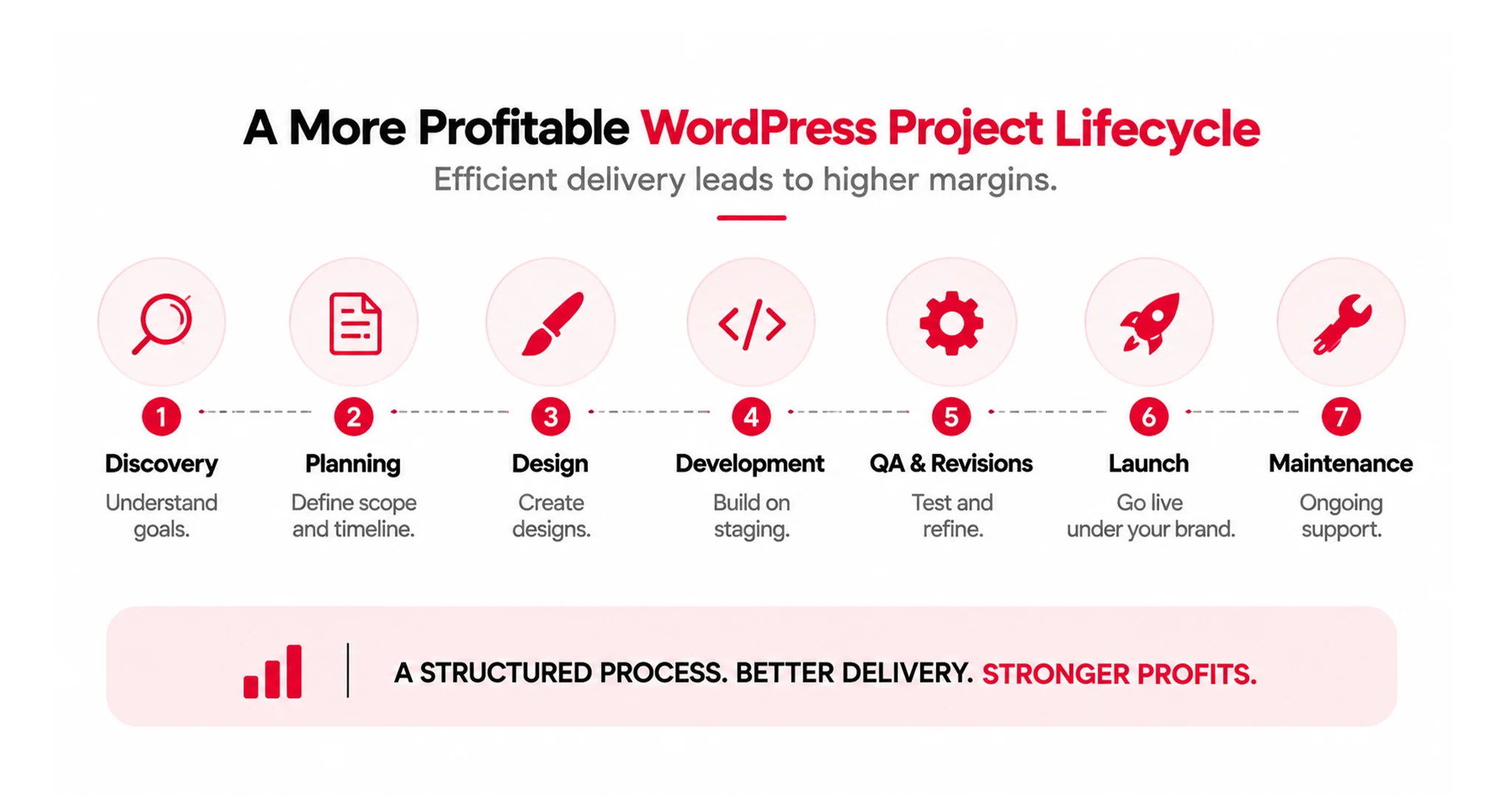
A More Profitable WordPress Project Lifecycle

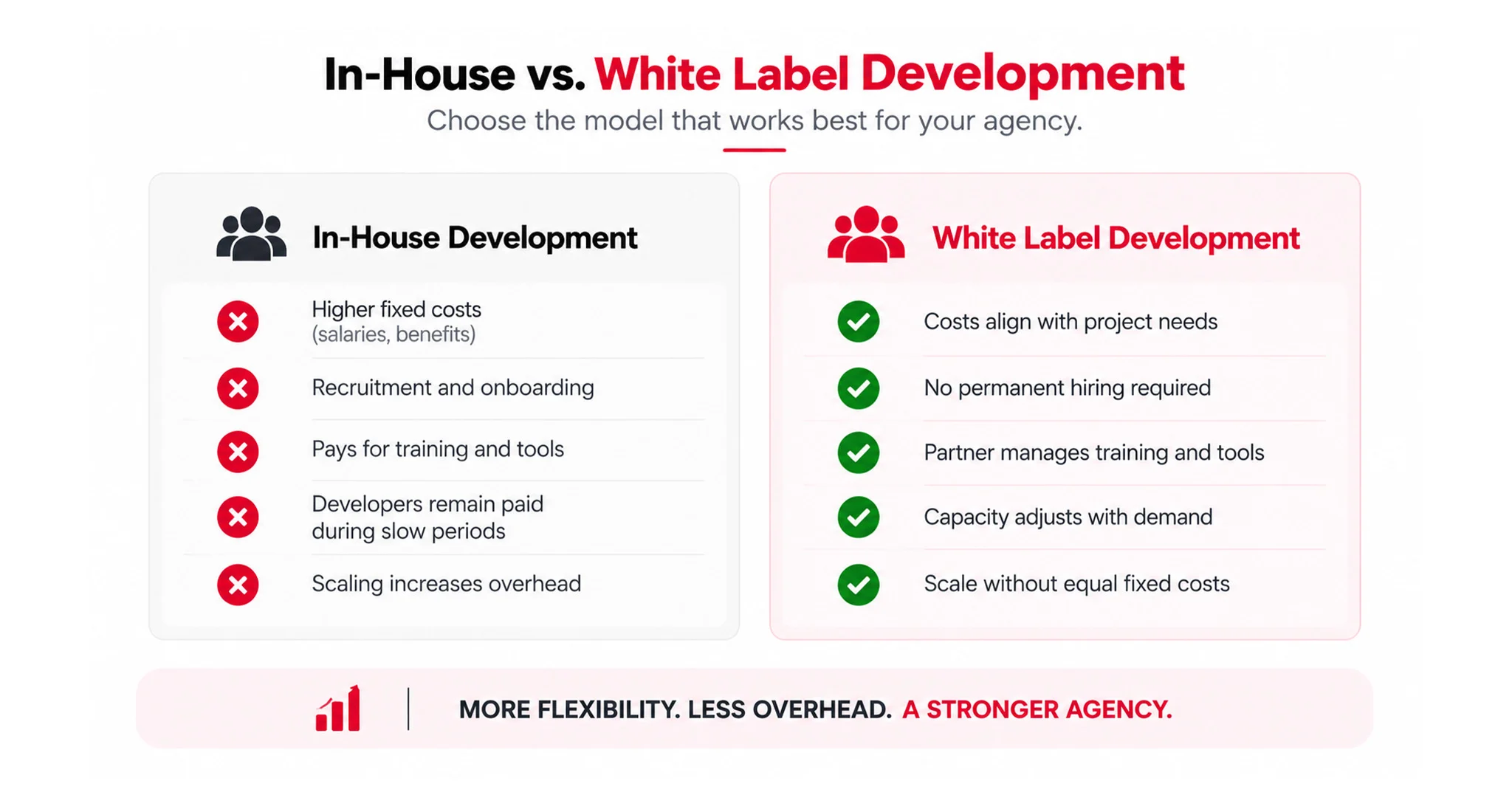
White Label vs. In-House WordPress Development: Which Is Better for profitability?

Factor In-House WordPress Team White-Label WordPress Partner
Cost structure Primarily fixed payroll and employment costs Usually project-based or retainer-based
Recruitment Requires hiring and onboarding No immediate internal hiring required
Capacity Limited to available internal resources Can expand according to project demand
Slow periods Agency continues carrying employee costs External capacity can often be reduced
Technical control Direct internal control Shared through agreed processes
Project management Managed internally May include partner-side project management
Specialized skills Requires internal hiring or training Can access external expertise as needed
Quality assurance Agency responsible for internal QA Partner may provide dedicated QA processes
Best fit Stable, predictable development demand Variable or growing project demand

There is no universal answer because profitability depends on project volume, technical complexity, employee utilization, management requirements, and long-term business objectives.

An internal team can provide greater direct control, while external development offers more flexibility when workloads fluctuate.

Agencies should therefore compare both models using their actual project economics instead of choosing based solely on salary figures or development quotations.

When an In-House WordPress Team Can Be More Profitable

An in-house team can be more profitable when development demand is stable, and the agency can consistently keep its technical resources productive.

  • Consistent Workload: Permanent developers become easier to justify when the agency has a steady flow of WordPress projects throughout the year.
  • Predictable Revenue: Stable project demand allows employee costs to remain closely connected with recurring development revenue.
  • Internal Expertise: Developers become familiar with the agency’s processes, client expectations, technical standards, and frequently used WordPress solutions.
  • Faster Delivery: Familiarity with recurring project requirements can reduce communication time and improve development efficiency.
  • Better Utilization: Agencies with consistently high developer utilization can potentially achieve stronger economics from an internal team.

When White-Label Development Can Improve Profitability

White-label development may support stronger profitability when agencies need flexible technical capacity without committing to permanent hiring.

The benefit depends on partner pricing, project quality, management requirements, and the agency’s ability to maintain appropriate client pricing.

  • Fluctuating Demand: External resources can help agencies manage periods when project volumes increase or decrease unexpectedly.
  • Specialized Skills: Agencies can access specific WordPress expertise without hiring permanent developers for skills they need only occasionally.
  • Service Expansion: External development can help agencies introduce additional WordPress services without immediately increasing their internal workforce.
  • Lower Hiring Pressure: Agencies can support new projects without committing to permanent payroll before future demand becomes predictable.
  • Flexible Capacity: A white label WordPress agency can provide additional development resources while the agency retains control over client relationships, strategy, and positioning.
In House White Lable Development

How Agencies Should Compare White-Label and In-House Costs

Agencies should compare:

  1. Average monthly development demand
  2. Average billable utilization
  3. Fully loaded employee cost
  4. White-label partner fees
  5. Internal project management hours
  6. Average rework and revision costs
  7. Recruitment and training expenses
  8. Expected workload during slow periods
  9. Required technical specialization
  10. Long-term ownership and control requirements

The relevant comparison is not salary versus outsourcing fees. It is the fully loaded cost of maintaining internal delivery capacity versus the total cost of external delivery.
Improve Your Development Efficiency

How to Choose a White-Label WordPress Partner Without Losing Your Margins

Evaluate Development Quality Before Price

Low development pricing means little if every project requires significant internal supervision and repeated corrections.

Review previous WordPress work, technical capabilities, communication standards, development practices, and experience with projects comparable to your requirements.

Ask how the team handles custom functionality, responsive implementation, integrations, performance considerations, and technical troubleshooting before making a commercial decision.

Reliable quality can reduce hidden agency costs that are difficult to identify when providers are compared only through their quoted development prices.

Check the Development Partner’s QA and Delivery Process

Quality assurance should happen before a project reaches your client rather than becoming your agency’s responsibility after delivery.

A reliable partner should have a defined testing process covering functionality, responsiveness, compatibility, usability, and common implementation issues.

Look for processes that include:

  • Requirement review before development begins
  • Internal testing before client delivery
  • Responsive and browser compatibility checks
  • Clear revision and issue-resolution procedures
  • Defined communication and delivery milestones

A structured QA process reduces the number of issues your account managers, designers, and internal developers need to identify manually.

You should also understand how reworks, updates, and iterations are handled when requirements change or delivered work does not meet agreed specifications.

Ensure Pricing Supports Your Target Margin

A development partner should fit your financial model rather than forcing you to redesign project pricing after every engagement.

Calculate expected client revenue, development expenses, project management time, rework allowances, and desired profit before accepting the quoted delivery cost.

The right partner should leave sufficient room for your agency to manage the account profitably while maintaining a competitive client price.

Transparent pricing also makes it easier to create repeatable service packages and establish minimum project margins across different WordPress offerings.

How QeWebby Helps Agencies Build a More Profitable WordPress Delivery Model

QeWebby supports digital agencies with white-label WordPress development designed around flexible capacity, clear communication, and predictable delivery processes. Our goal is to help agencies expand their technical capabilities without taking on unnecessary permanent development overhead.

Flexible WordPress Development Capacity

QeWebby helps agencies access dependable WordPress development capacity without requiring them to build and maintain every technical resource internally.

Structured Technical Delivery

Agencies can extend their delivery capabilities for individual projects, recurring workloads, or periods when internal development resources are already fully committed.

Agency-Centered Communication

Agencies remain responsible for client relationships, communication, strategy, and overall project direction while QeWebby supports the technical execution.

Quality Assurance and Revisions

A flexible development structure can help agencies manage technical expenses according to actual project requirements instead of carrying excess permanent development overhead.

Scalable Partnership Models

QeWebby can function as an extension of an agency’s delivery team, helping businesses pursue additional opportunities while building a more scalable and profitable WordPress service model.
Start A Project Discussion

Conclusion

Strong agency margins depend on more than increasing project revenue. They require careful control of development costs, resource utilization, project scope, quality, and management time.

White-label WordPress development may help agencies increase technical capacity without immediately expanding permanent payroll. However, the model is most effective when partner costs, internal management, revisions, QA, and client pricing are evaluated together.

The right delivery structure depends on project volume, technical requirements, internal expertise, and long-term business objectives. Agencies should test potential partners through a clearly scoped project and evaluate quality, communication, documentation, and profitability before establishing an ongoing relationship.

If your agency is looking for flexible WordPress development capacity, QeWebby can help you explore a delivery model suited to your requirements.
The Ultimate Guide to White Label Web Development for Agencies

Agency owners treat a hiring plan as the default answer to cope with massive workloads. However, the numbers behind that plan rarely survive the bottlenecks of the actual talent market.

McKinsey’s March 2025 analysis of the technology talent gap highlights talent scarcity as a significant barrier to digital transformation. For agencies, this raises an important operational question: Is hiring the fastest and most sustainable way to increase development capacity?

So the question is not whether your agency needs more development capacity. It is whether a hire is even the fastest way to get it. This is where white label web development enters the picture, and where most guides stop at a definition instead of the decision behind it.

This guide explains how white label web development works, how it differs from other delivery models, what costs and risks to consider, how project handoffs are managed, and when hiring or another partnership model may be a better fit.

What is White Label Web Development?

Most agencies think white labeling is just outsourcing with better manners. However, once you look at how the contract, the brand, and the client relationship actually work, the difference is structural, not cosmetic.

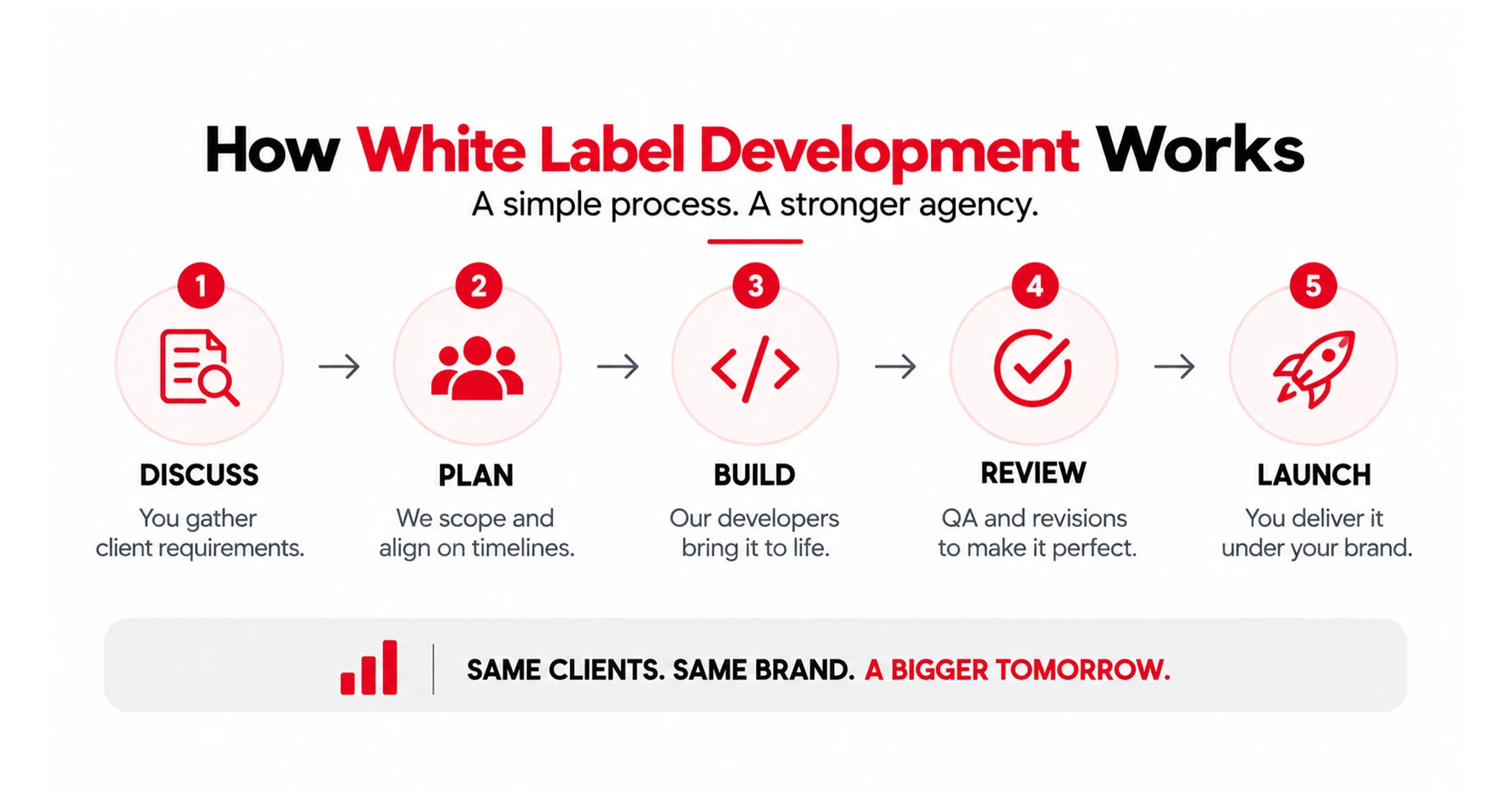
White Label Web Development is a B2B arrangement where a specialized third-party development company builds websites, web applications, or digital products on behalf of another agency. Your agency buys these white-label web development services at wholesale rates, sets your own retail pricing, and sells the finished work entirely under your own brand.

The development partner runs as a silent execution engine behind the scenes. They stay 100% invisible to the end client. No code footprints, meta tags, style sheet credits, directory paths, or branding traces link the site back to the backend partner. Your agency keeps full ownership of the client relationship, the strategy, and the credit for the delivered product.

So, what does this actually cover?

Custom builds across WordPress, Webflow, Shopify, and React. E-commerce setup, custom database configuration, API integrations, and ongoing post-launch maintenance retainers. The scope is the full technical execution layer, not a slice of it.

Explore White Label Development Services-1

What White Label Web Development is Not

The issue at hand is that “white label” gets used loosely across six different structures. Each one shifts risk, control, or margin differently. Here’s where the line actually sits.

1. Not Traditional Outsourcing

Traditional outsourcing hires an external vendor to deliver a project, but it typically skips brand integration. The end client usually knows a third party is doing the technical work.

When providing white label web development services, the partner operates as a seamless, invisible extension of your agency. The team signs strict Non-Disclosure Agreements (NDAs), works behind neutral or agency-branded staging environments, integrates into your project management tools like ClickUp, Slack, or Asana, and can even run an alias email under your domain, for example [email protected].

2. Not Freelancing

Freelance developers are a common tactical move. However, this route carries real systemic risk: inconsistent quality, fragmented accountability, no project management, and the chance a developer ghosts mid-build.

A proper white label web development agency hands you a full project team, project managers (PMs), UI/UX designers, developers, and QA testing protocols.

3. Not a Reseller Model

Reseller programs sell a named, visible third-party SaaS platform to your clients at a set markup. The reason behind such a scenario is simple: the vendor’s brand stays fully visible, so your agency has limited pricing control and constant risk of the client going straight to the vendor.

In white-label web development, the supplier’s identity is stripped out entirely. This is where the model gives your agency 100% pricing autonomy and client retention.

4. Not a Commission or Referral Program

Commission programs are simple: you pass a lead to a software vendor or dev firm and take a percentage of the sale. Once you refer the client, you give up pricing, delivery quality, and long-term retention.

In a white-label model, you own the contract, the billing relationship, and the deliverable.

5. Not a Joint Venture

A Joint Venture (JV) is co-branded and co-managed, with two entities splitting operational responsibility and revenue on a pre-negotiated split, typically 50/50, often with combined pitch decks and joint client meetings.

White labeling is structurally a customer-supplier relationship. The provider builds the site at a wholesale rate, and your agency marks it up, typically targeting 50 to 70% gross margins, and keeps 100% of the profit.

Explore White Label Development Services

Why Agencies Are Shifting to White Label Web Development

Most agencies believe growth is a headcount problem: more clients means more developers on payroll. However, that relationship breaks the moment a growth curve isn’t perfectly linear, and agencies are turning to white label web development to fix exactly that bottleneck.

So, what’s actually driving the shift? Here are the reasons.

1. Breaking the Linear Scaling Bottleneck

In traditional growth models, taking on more client accounts forces a proportional increase in in-house technical headcount. However, running a full-time internal engineering department carries real fixed costs.

This fixed cost becomes a liability the moment client volume dips, whether from seasonality or a broader downturn. White label partnerships can also help agencies expand their ecommerce service offerings

Verdict: fixed engineering headcount scales with your worst month. Variable white label capacity scales with your actual pipeline.

2. Resolving Talent Scarcity and Sourcing Risk

Recruiting and onboarding technical talent is slow. The reason behind such a scenario is straightforward: qualified developers are in short supply relative to demand, and hiring cycles routinely stretch across months.

Freelancers are one workaround. However, freelancing carries systemic risk: inconsistent delivery quality, no structured project management, and the real chance a developer disappears mid-project.

A structured white label web development agency solves this differently by handing you a full team, project managers, developers, and QA, with built-in redundancy, so the project keeps moving even if one person is unavailable.

Verdict: a white label partner replaces individual hiring risk with team-level redundancy.

3. Expanding Service Portfolios and Deal Size

Clients increasingly want one full-service partner instead of five fragmented vendors. That preference puts pressure on specialized shops, SEO-only or branding-only agencies, to add web development to the menu.

Partnering with a provider for full-stack white label website development adds those platforms to your service menu without adding headcount.

So, what does that unlock? The ability to sell platform builds and custom development alongside your existing services, instead of referring that work out and losing the margin entirely.

Verdict: portfolio breadth is what turns a single-service vendor into a full-service agency of record.

4. Accelerating Speed to Market

Recruiting and onboarding a new in-house developer is a multi-month process end to end. An established white label partner, by contrast, already has the team in place. Scoping and kickoff timelines run in days rather than months, because there’s no hiring cycle standing between the brief and the build.

This is where speed compounds: faster kickoff means faster delivery, which means your agency can commit to tighter client timelines without overstaffing to hit them.

Verdict: the fastest path to shipping a client site is a team that already exists.

5. Creating Predictable, High-Margin Revenue

Offshore white label developers, often based in talent-dense hubs like India, typically operate at a lower cost basis than US or UK in-house hires. Your agency buys development at wholesale rates and resells it at your market rate, capturing the margin between the two.

Post-launch maintenance is the second revenue layer. Security updates, performance tuning, and general upkeep wrap into a monthly retainer that your agency marks up and bills recurring.

Verdict: white label execution turns one-time project revenue into a recurring, marked-up line item.

6. Freeing Teams for High-Value Work

Managing code, server deployments, database integrations, and technical troubleshooting pulls agency leadership away from growth work. So, what happens when a white label partner absorbs that layer silently?

Your internal team redirects its attention to client relationships, account strategy, creative direction, brand positioning, and selling- the work that actually grows the agency.

Verdict: the technical execution layer and the growth layer are different jobs, and white labeling lets you staff them separately.

Ultimately, the scaling bottleneck isn’t a talent problem or a tooling problem. It’s a cost-structure problem, and white label web development is the mechanism that fixes it.

Talk to Our Development Team new

How a White Label Web Development Partnership Actually Works

Most agencies picture a white label partnership as a ticket queue: submit a request, wait, hope for the best. However, a properly run partnership behaves nothing like that. It functions as an invisible, full-service engineering department, one where your agency keeps absolute ownership of the client relationship, the brand narrative, and the margin.

So, what makes that operating reality possible? Structured standard operating procedures (SOPs), integrated communication systems, and strict legal protocols. Here’s how the mechanics actually run.

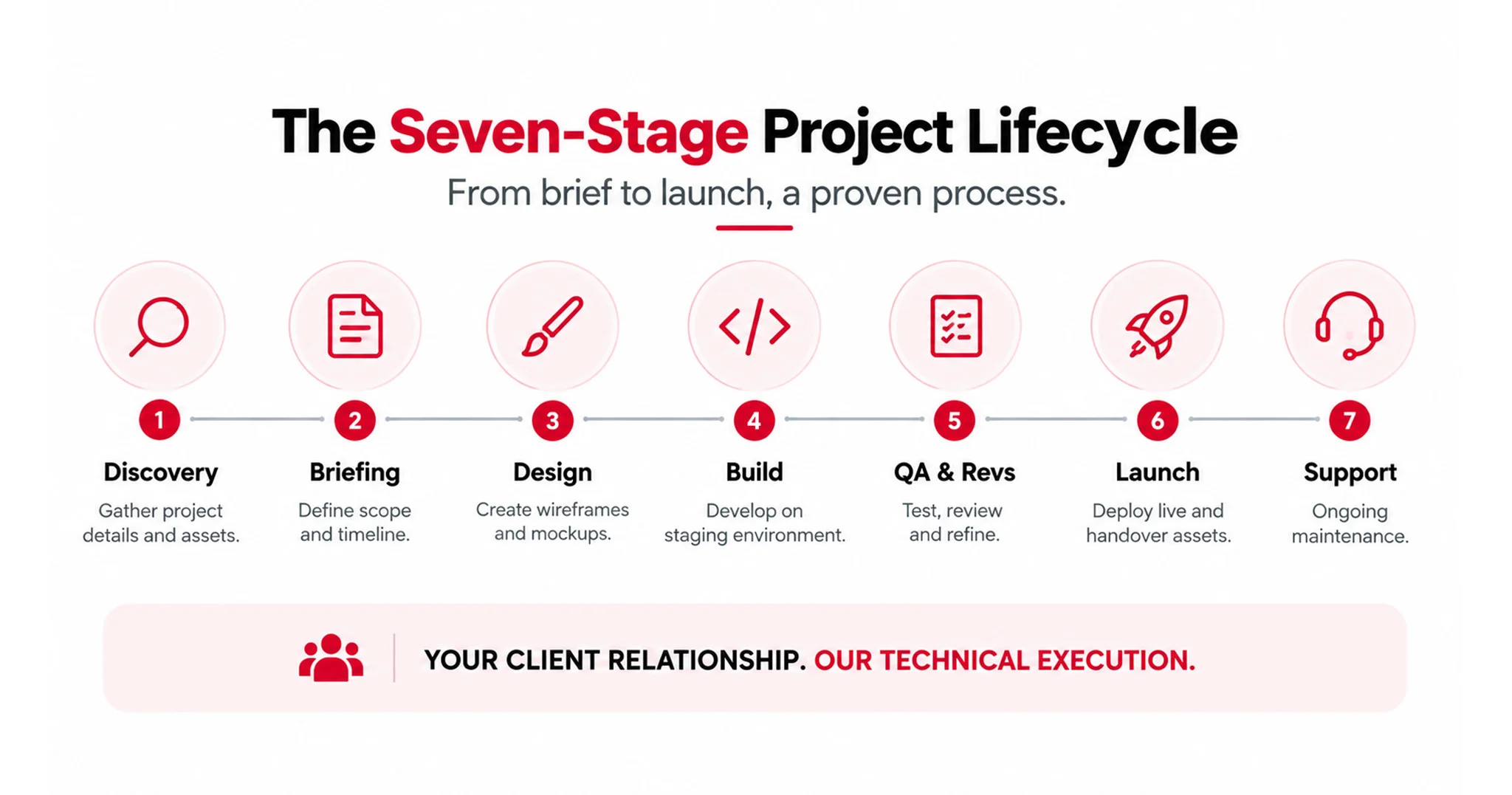
1. The Seven-Stage Project Lifecycle

A successful build follows a repeatable, stage-gated pipeline. This is where ownership boundaries get drawn: your agency faces the client, the partner faces the code.

THE SEVEN-STAGE LIFECYCLE
1. Discovery Agency gathers sitemap and assets from client
2. Briefing Agency translates brief; partner locks scope/timeline
3. Design Visual wireframes/mockups signed off before coding
4. Build Partner writes code in isolated staging environments
5. QA & Revs Joint review passes; structured revisions completed
6. Launch Partner deploys live; hands over rebranded assets
7. Support Transition to monthly white-labeled maintenance

Discuss Your Next Project

Stage 1: Discovery and Requirements Gathering

You are the main strategic consultant for your agency, meeting with the end client to gather your client’s business objectives, target audiences, brand guidelines, and page count requirements. At this point, it’s all up to you and your agency. That’s what keeps partner invisibility safe during white label website development.

A good way to get started is to ask the client what he or she doesn’t like about the existing website, rather than asking what they want. This question helps to identify more technical pain points.

Stage 2 Briefing & Planning

Your agency passes over the creative brief, layout files, API needs, and branding elements to the white-label developer. The Developer will review all the above and identify the areas of gaps along with a fixed scope quote with a locked timeline and milestone dates.

Stage 3: Design, Wireframing, and Prototyping

Designers use the requirements to create visual sitemaps, wireframes, and interactive mockups, mostly in Figma. A designer uses the requirements to build visual sitemaps, wireframes, and interactive mockups, mostly in Figma.

Client sign-off on the mock-up is required. The answer to such a situation is very simple- when making changes to the layout, it is inexpensive to do so in a design file, but once development is underway, it is costly to make changes.

Stage 4: Build Execution and CMS Configuration

The development partner now takes over once the design is agreed to. They write code for the front-end of the site, create custom back-end databases, and connect third-party tools, e.g., CRMs or payment gateways. Preventing client-facing errors, each build is performed on isolated and secure staging servers instead of live servers.

Stage 5: Internal QA & Structured revisions:

The build is subjected to a comprehensive checklist by the partner’s own Quality Assurance (QA) team before it’s ever viewed by the agency: mobile responsiveness, cross-browser compatibility, form submission, and Web Content Accessibility Guidelines (WCAG) standards and Core Web Vitals page speed.

Your agency checks the website, then leads the client through a series of steps to revise the site, usually two to three rounds of revisions as outlined in the master agreement.

Stage 6: Launch and Handover

Once the white label web development services are complete and the client signs off, the partner will handle live deployment. After they are live, they provide you with all their clean source code, credentials, and documentation with your brand name.

Stage 7: Continuous Maintenance and Support:

The project is handed over to the partner’s maintenance team. They ensure that there are no downtimes, they install security patches, and they execute backups in your agency’s name. Recurring revenue begins here: Your agency sells the client maintenance retainers at a high premium.

Verdict: the seven stages exist to draw one line clearly: client-facing work stays with your agency, execution work stays with the partner, and the two never cross.

Talk to Our Development Team

2. How Invisibility is Maintained in Practice

A partnership only holds up if the developer stays completely hidden. Agencies enforce that through three operational pillars.

Email Aliases And Name Masking

If the development team needs to join client calls, they’re introduced under your agency’s banner, as your “senior dev team lead” or “engineering partners,” with zero mention of their independent brand. Where direct client email is necessary, the partner works under an alias on your domain, for example [email protected].

Neutral Staging Environments

Staging URLs and client-review portals are fully white-labeled, configured on neutral domains or your agency’s subdomains, for example staging.youragency.com, with your agency’s logo on the login screen.

Zero-Footprint Code Cleanliness

A genuinely professional white label web development agency strips all metadata. Stylesheets, theme folders, databases, plugins, and source code comments get scrubbed of any trace of the third-party developer’s brand. A technically curious client should not be able to find the seam.

Verdict: invisibility isn’t a courtesy; it’s an operational discipline enforced at the domain, login screen, and code comment level.

3. Integrated Workflows and Communication

The partner doesn’t operate as an isolated black box where you submit tickets and wait. However, a properly structured partnership makes them an active extension of your team instead.

Dedicated project managers (PMs). You get a single, named point of contact acting as your account lead. Your agency’s PM communicates directly with the partner’s PM, which keeps client feedback translation clean and avoids the telephone-game problem.

Shared project dashboards. The partner plugs directly into your existing project management stack, ClickUp, Slack, Asana, or Jira. Your team sees sprint boards, active milestones, and QA reports in real time.

Asynchronous rhythms. For teams spread across time zones, offshore developers in India optimizing build cost is a common setup; a daily asynchronous update rhythm keeps both sides aligned. A short written summary at the end of each workday replaces the need for constant live syncs.

Verdict: the difference between a black-box vendor and a real extension of your team is whether you can see the sprint board without asking for it.

4. Legal and Structural Safeguards

Before a single project asset or database changes hands, three contracts formalize the relationship and protect your agency’s brand equity.

Non-Disclosure Agreement (NDA)- binds the partner to absolute confidentiality, contractually prohibiting them from claiming credit for the work, showcasing your projects in their portfolio, or disclosing the relationship with your agency.

Non-solicitation and non-compete clauses- prevent the developer from poaching your clients, pitching services directly, or bypassing your agency in any way.

Intellectual Property (IP) assignment- specifies that 100% of the custom source code, design assets, and licenses transfer to your agency on final payment, so you’re never locked into one vendor and can take the code wherever you need to.

Verdict: the NDA protects your invisibility, the non-compete protects your client base, and the IP assignment protects your leverage. Skip any one of the three and the arrangement stops being white label and starts being a liability.

Ultimately, a white label partnership works because every stage, every communication channel, and every contract is built around one line: your agency owns the relationship, the partner owns the execution, and neither side crosses it.

Schedule a Consultation

Final Thoughts

The decision is not “should my agency use white label web development.” It is “do I hire, or do I partner, at my current volume,” and that question has a number attached. Deloitte’s 20%-plus savings figure for centrally governed delivery, and McKinsey’s finding that 60% of companies name talent scarcity as a transformation blocker, both point the same direction for any agency running below its break-even volume: a partner wins on cost and on hiring risk until volume says otherwise.

So, run a scoped pilot project before you run a hiring process. It answers the question faster, and it costs less to be wrong when testing white label web development services

Headless WooCommerce With Next.js: A Practical Guide to Cost, Performance & Migration

For high-volume ecommerce stores, site performance can have a measurable impact on engagement and conversion. As catalogs, integrations, and traffic grow, however, maintaining a fast WooCommerce storefront can become increasingly complex.

When conventional optimization is no longer enough, some brands consider a more fundamental architectural change. This is where the decision to go headless becomes relevant.

Going headless with Next.js can give your team more control over rendering, caching, JavaScript delivery, and frontend architecture. But headless does not automatically make a store faster. Performance still depends on implementation, API architecture, caching, hosting, image optimization, third-party scripts, and the complexity of the storefront.

This guide provides a practical decision framework for implementing Headless WooCommerce with Next.js, including the technical considerations, migration requirements, and total cost of ownership.

WooCommerce Headless Assessment Get

What is Headless WooCommerce?

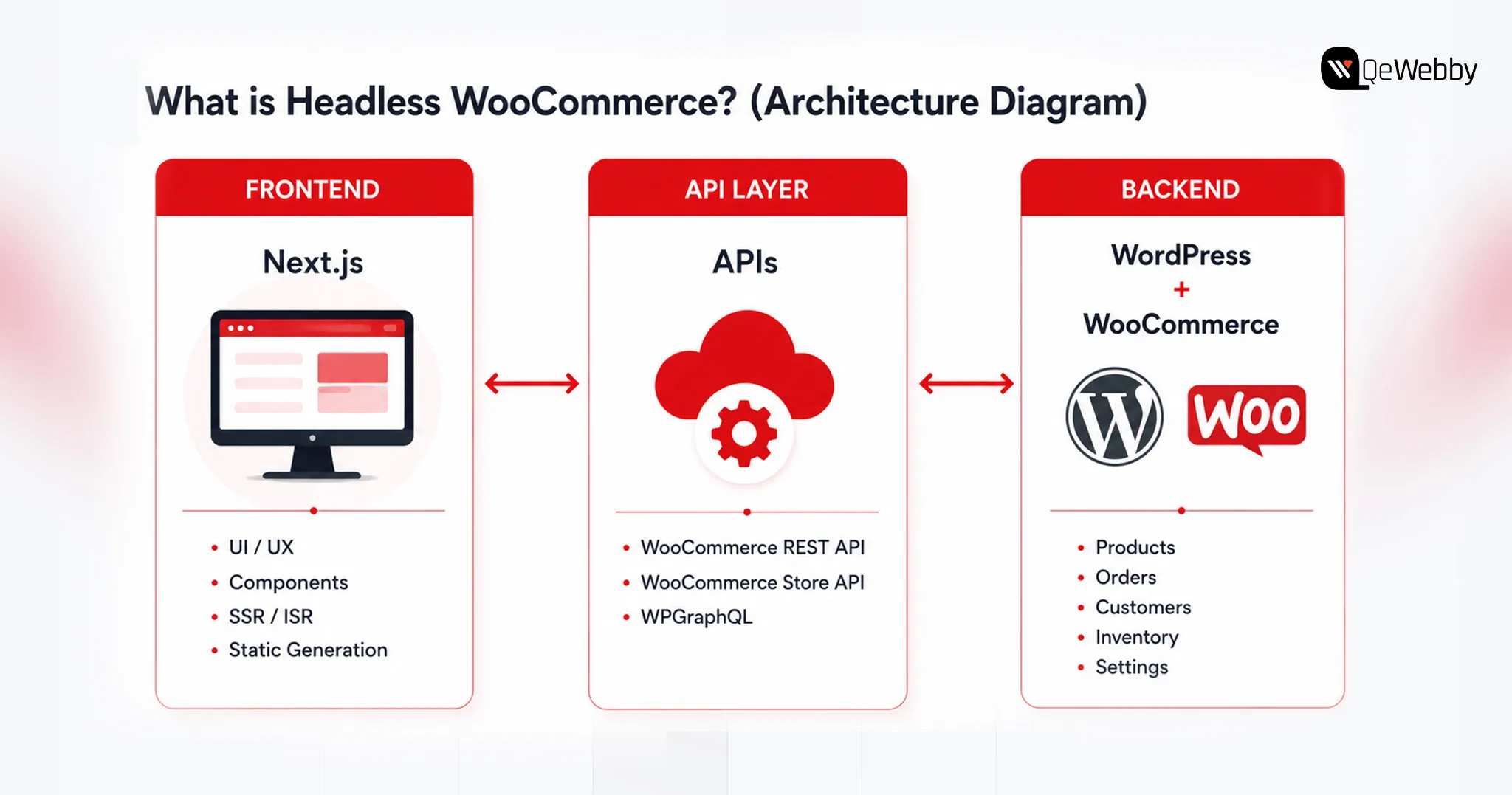
Headless WooCommerce separates the customer-facing frontend from the WordPress/WooCommerce backend, allowing the two layers to evolve independently while communicating through APIs.

In a conventional WooCommerce setup, WordPress operates as the monolith. It manages the database and uses PHP-based themes to generate HTML and visual design.

This decoupled system has three distinct layers,

  • Backend as the engine – Your WordPress and WooCommerce installations continue to manage the core commerce operations, including product catalogs, inventory, pricing, taxes, shipping, customers, and orders. Your team can continue using the familiar WordPress admin interface while the customer-facing frontend is handled separately.
  • Frontend as the experience you serve- With Next.js, your customer-facing storefront will be transformed, offering a modern, high-performance experience. With JavaScript at its core, Next.js offers higher flexibility for frontend development, and with the backend being decoupled, you can use edge-rendering content delivery networks.
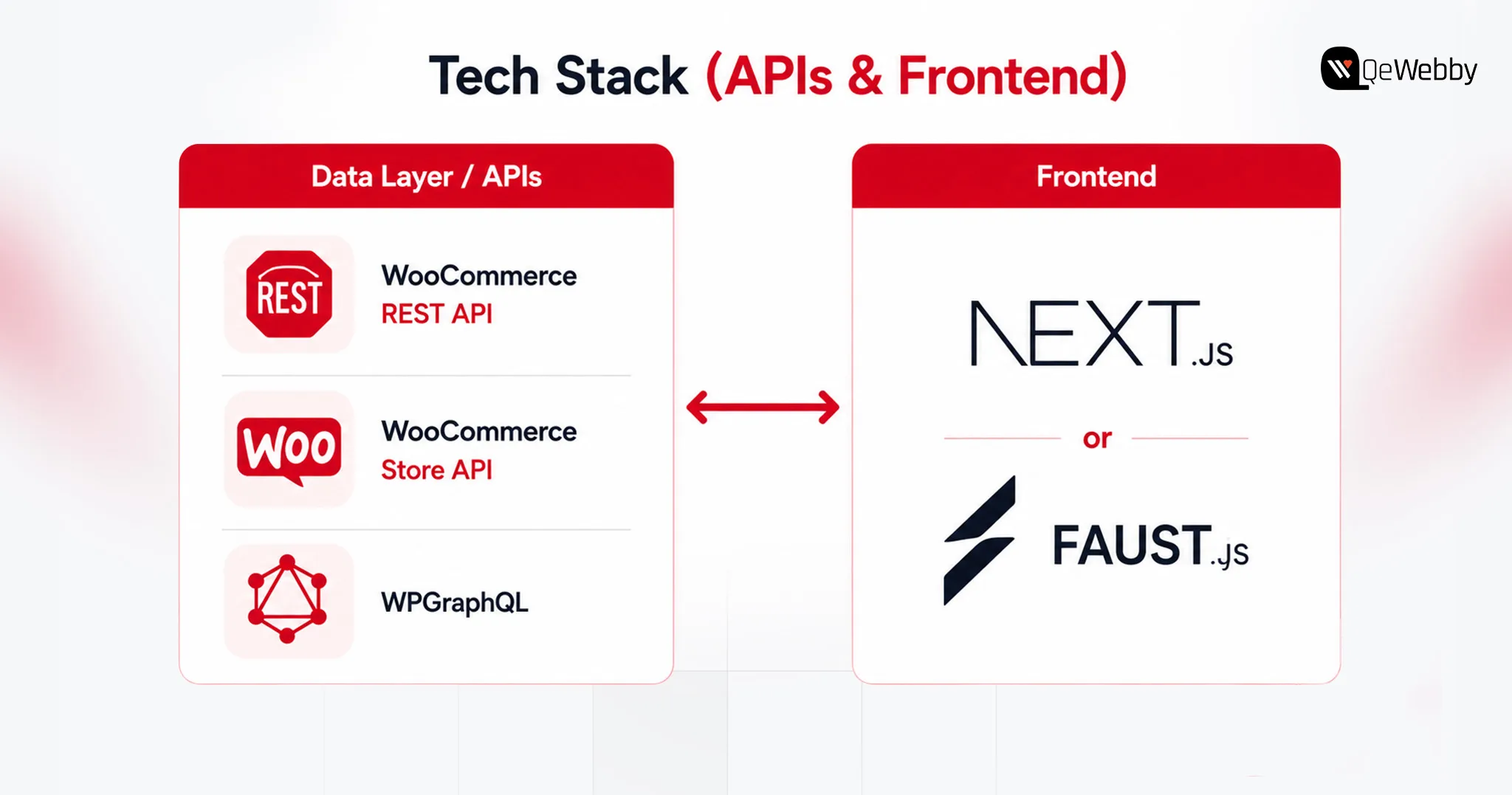
  • API Layer as the bridge between frontend and backend- APIs help your frontend and backend communicate while they are decoupled. You can leverage endpoints like WooCommerce REST API, the WooCommerce Store API, or WPGraphQL. These APIs allow the frontend to request the data it needs while keeping business logic and sensitive backend operations within the appropriate server-side environment.

Using headless WooCommerce with Next.js removes many of the frontend constraints associated with conventional WordPress themes. This moves much of the customer-facing rendering work away from the traditional PHP theme layer, giving developers more control over frontend performance and architecture.

The important question is not whether headless is technically possible, but whether its benefits justify the additional development and maintenance complexity for your store.

Why Stores Are Going Headless: The Performance & Revenue Case

The case for headless is broader than page speed. For some ecommerce brands, the real value is frontend flexibility, faster experimentation, omnichannel delivery, and greater control over how content and commerce experiences are built.

Headless WooCommerce can give development teams greater flexibility when building new storefront features, experiences, and integrations. Better page performance can support user experience and Core Web Vitals, which are among the signals Google uses in evaluating page experience. However, moving to headless does not automatically improve search rankings.

And using headless WooCommerce with Next.js, brands can,

Get Speed Gains

WooCommerce’s monolithic architecture generally makes conventional online stores unnecessarily fat, and prevents easy “tree-shaking” or code-splitting of plugin scripts. What this means for an eCommerce brand is higher loading time, which impacts user experience and conversions. However, with Next.js you can ensure,

What Next.js can improve:

  • More control over server-side rendering and static generation
  • More granular caching and CDN delivery
  • Reduced dependence on PHP theme rendering for the storefront
  • Better control over JavaScript bundles and component loading
  • More control over the factors that influence Core Web Vitals
  • Greater freedom to build custom shopping experiences

The actual performance gain depends on implementation. Headless is an architectural option, not a performance guarantee. A poorly implemented headless storefront can still suffer from slow LCP, excessive JavaScript, inefficient API calls, third-party scripts, and poor Core Web Vitals.

Conversion + SEO impact

Google’s Core Web Vitals directly connect the three dimensions of loading speed, interactivity, and visual stability with search engine rankings and customer behavior. The money impact of meeting these metrics is tremendous, not just in SEO. Deloitte’s research across 37 brands found that a 0.1-second improvement in mobile site speed was associated with an 8.4% increase in retail conversions and a 9.2% increase in average order value.

SSR and ISR can make important page content available as rendered HTML while giving developers greater control over metadata, structured data, internal linking, and page performance. However, headless architecture itself does not guarantee better SEO; implementation still matters.

Slowing Requests Audit

The Headless-Commerce Market Signal

Headless commerce has become increasingly common among larger brands that need highly customized digital experiences, multiple customer touchpoints, or greater control over their frontend architecture.

Headless commerce has become more common among larger brands that need highly customized digital experiences across multiple channels. However, the architecture used by enterprise brands should not automatically be treated as the right architecture for a mid-market WooCommerce store.

Decoupling can reduce the amount of frontend rendering work handled by the WordPress theme layer and can provide more flexibility around caching and content delivery. However, checkout, cart operations, APIs, and backend transactions can still become bottlenecks under load.

Tech Stack APIs Frontend

How Much Does Headless WooCommerce Cost? (2026 Budgets)

Budgets on a headless rebuild land in a different bracket than standard WooCommerce, and the gap comes down to custom API work, catalog complexity, and specialized talent.

Typical Project Ranges

A typical WooCommerce implementation may fall in the $5,000–$30,000 range, depending on design, functionality, integrations, and customization.

Headless Next.js implementations typically require a larger initial investment because they introduce separate frontend development, API integration, testing, infrastructure, and ongoing maintenance requirements.

These are planning ranges rather than fixed market rates. Actual costs vary significantly based on catalog size, design requirements, integrations, plugin replacements, checkout complexity, migration scope, content modeling, and engineering location.

Cost Consideration Standard WooCommerce Headless Next.js
Initial build $5,000 – $30,000 $60,000 – $150,000+
Hosting $100 – $300/mo $300 – $1,000+/mo
Maintenance Lower Higher
DevOps Usually limited Often required
Plugin redevelopment Lower Potentially significant
TCO Highly variable Highly variable

Calculate Real Cost Estimate

What Drives the Number

Timeline is the biggest lever, 14–22 weeks versus 8, and labor cost scales with it. Frontend-dependent plugins such as wishlists, loyalty programs, product customizers, and certain membership features may require API integration or frontend redevelopment in a headless setup. Each gets rebuilt in React or Next.js, alongside custom cart state and payment tokenization logic.

Large catalogs add weight too, mapping custom fields into GraphQL fragments and building webhook-based cache invalidation so inventory and pricing stay accurate without forcing a full site rebuild.

Build vs. Partner

A single change can touch WordPress, the API layer, and the frontend at once, demanding dual PHP and React/Next.js expertise. Specialized engineers with WooCommerce/PHP, React/Next.js, API, and DevOps experience can be expensive to hire and difficult to keep fully utilized if headless work is intermittent. Troubleshooting gets harder too, since a bug can originate in any of the three layers.

For organizations without the required internal expertise, working with a headless WordPress agency can reduce the burden of building and maintaining the architecture internally.

How to Actually Build It: Stack & Migration Roadmap

Building headless WooCommerce means replacing the traditional customer-facing WordPress theme with a separate Next.js frontend that communicates with WooCommerce through APIs.

Here’s how the stack and migration typically shake out.

Pick The Data Layer (REST vs WPGraphQL)

Routing data through the right API layer decides both security and performance.

  • REST API (v3): Authenticated REST API requests should not expose consumer secrets in the browser. Server-side requests or a secure backend layer should handle credentials when authentication is required.
  • Store API: The Store API is designed for customer-facing cart and checkout interactions and uses WooCommerce’s session mechanisms rather than requiring the same credential model as authenticated REST API requests.
  • WPGraphQL: WPGraphQL provides the WordPress GraphQL layer, while WooGraphQL exposes WooCommerce-specific data through GraphQL. ACF can then expose structured custom fields when the content model requires them.

Choose the Frontend Framework (raw Next.js vs Faust.js)

  • Raw Next.js: Full control over SSR, ISR, and architecture, but you hand-build the Apollo client and GraphQL queries yourself. Leaner dependency tree, more upfront engineering.
  • Faust.js: Faust.js is a WordPress-focused framework built on Next.js that provides conventions and tooling for common headless WordPress requirements. It can reduce setup work, although teams should evaluate its current ecosystem and fit against a more custom Next.js architecture before choosing it.

Cart, checkout, SEO, and previews

PHP session cookies don’t survive a cross-domain frontend, so Cart state can be managed through WooCommerce’s Store API, including its cart-token mechanism, or through a solution such as CoCart. The implementation determines how sessions or cart tokens are persisted and passed between the frontend and WooCommerce.

For checkout, redirecting to WooCommerce’s native checkout is the most reliable path; a fully custom headless checkout with client-side tokenization (Stripe, for example) works too, but demands real API development.

SSR and ISR can mitigate some SEO and rendering challenges associated with client-heavy JavaScript by making important content available as server-rendered HTML.

Bridge Yoast or Rank Math metadata through GraphQL and rebuild schema markup on the frontend to keep it intact. For editors, Next.js Draft Mode plus a WordPress-minted JWT preview token lets them view unpublished drafts without exposing them publicly.

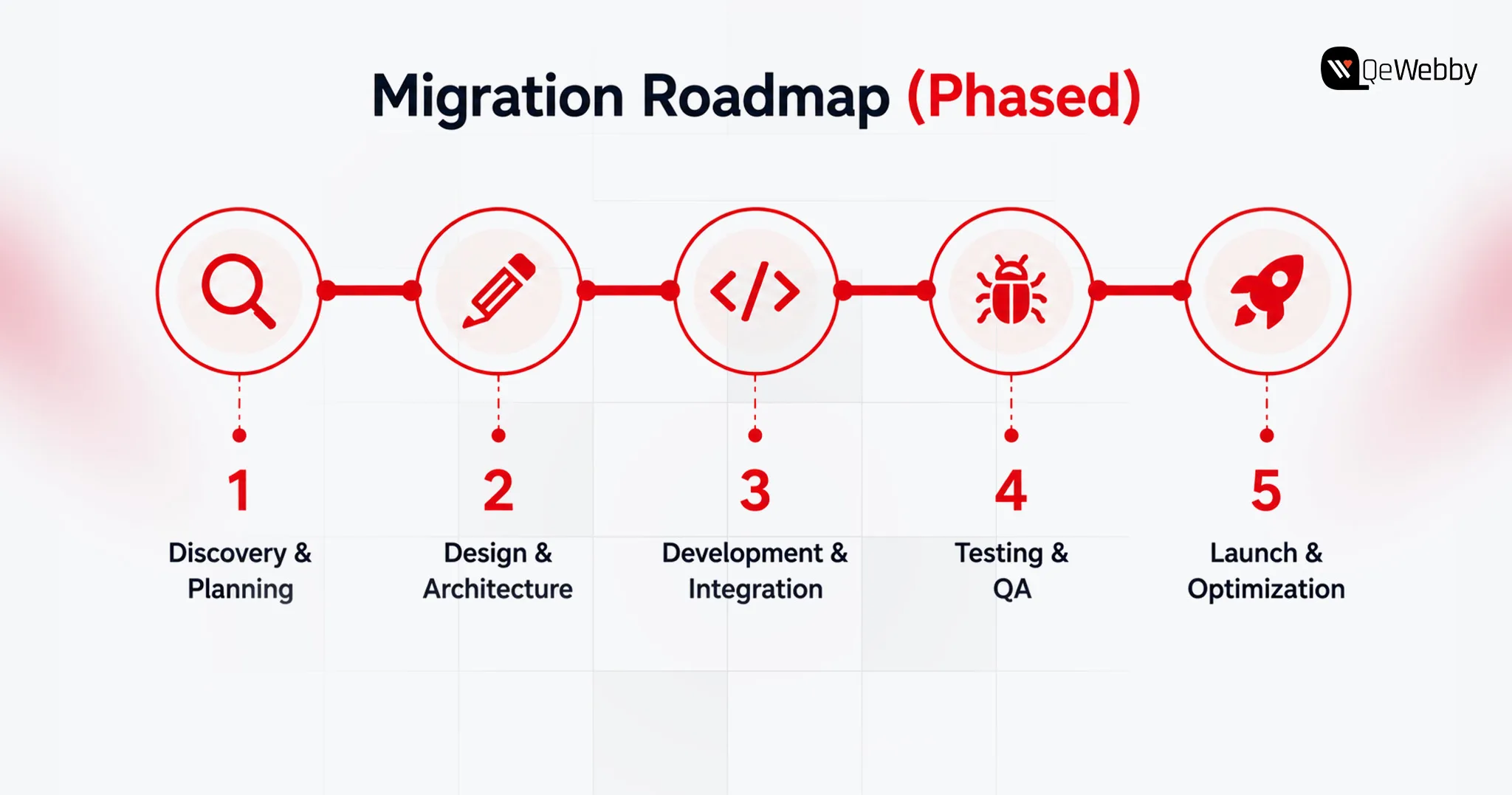
Phased Migration and Testing

Elementor, Divi, and similar page builders often store presentation-specific structures that do not map directly to a Next.js component system. During migration, those layouts may need to be extracted, modeled, and rebuilt as React components or structured content blocks.

SEO Migration and URL Mapping

Before launch, map every existing URL to its corresponding new URL. Implement 301 redirects where URLs change, preserve metadata and canonical tags, regenerate XML sitemaps, and crawl the staging environment for broken internal links and missing pages. Monitor Search Console after launch for indexing and coverage issues.

Here are a few points to consider when deciding between Headless WooCommerce, Traditional WooCommerce, and Shopify Headless.

Migration Roadmap

Headless WooCommerce vs Traditional WooCommerce vs Shopify Headless (Decision Matrix)

Decoupling is a business decision, and not simply a technical one: it’s a tradeoff between simplicity and speed and control.

Compare on speed, cost, control, maintenance, best-fit store size

The Shopify Headless column reflects standard enterprise SaaS benchmarks and the rent-vs-own tradeoff, since the underlying data focuses on WooCommerce and Next.js.

Factor Traditional WooCommerce Headless WooCommerce (Next.js) Shopify Headless (Enterprise SaaS)
Frontend performance control Moderate High High
Backend ownership High High Lower
Initial cost Lower High High
Maintenance Lower Higher Moderate
Plugin compatibility Highest Requires evaluation/rebuild App/API dependent
Backend infrastructure Self-managed Self-managed Platform-managed
Checkout complexity Lower Higher Moderate–High
Custom frontend freedom Moderate Very high Very high
Infrastructure responsibility Lower Higher Lower
Best fit Most stores Complex/highly customized stores Enterprise brands wanting SaaS infrastructure

WooCommerce Architecture Diagram

Store Outgrown Book A Technical

Conclusion

Go headless when the business has a clear reason to own a more flexible frontend architecture and can support the additional development and maintenance burden. Stay with traditional WooCommerce when plugin compatibility, simplicity, speed of implementation, and lower total cost matter more than frontend architectural control.

Go headless if:

  • Your existing frontend architecture is limiting growth
  • You need highly customized experiences
  • You have engineering resources
  • Your integrations justify API-first architecture
  • You can support higher TCO

Stay traditional if:

  • Your current store performs well
  • Your plugin ecosystem is important
  • You need to launch quickly
  • Your team lacks React/API/DevOps expertise
  • Headless doesn’t solve a clearly measurable business problem

Run your own numbers against the cost and decision breakdowns above, then bring them to a headless WordPress partner before you commit a rebuild budget.

talk to qa specialist